
Morning, morning, morning - very happy to have you back here as How We Listen reaches its fourth issue! I’m listening to unpeople’s impressive debut record as I write this - you should check it out too. A band that will be (and already is) getting up to big things.
Alongside this week’s interview with our guest Hamley Jenkins - more on her shortly - by scrolling down you’ll also get some articles I’ve read these past couple weeks that I found appealing for different reasons and that you might enjoy too, plus our 4th mixtape with 7 new tracks: I’m 100% sure you’ll find at least one you love in there. The band Guillotine is on the cover of this one.
That’s what you get with every issue of How We Listen, by the way: an interview with a guest who absolutely loves music, exploring the (very cool) things they do, how they ended up doing that, and the ways they discover music. And the aforementioned recommendations. If you haven’t yet - I strongly suggest you check out last issue’s interview with Joey La Neve DeFrancesco of musicians’ union UMAW. It’s my favorite one so far.
I’ll try not to mention it more than once in this article, but if you like what you’re seeing here - you can start getting these issues straight in your inbox by subscribing for free.
I just turned thirty last week, by the way. If you feel inclined to give me a birthday present, sharing the newsletter with a friend (or friends, plural!) is more than plenty.
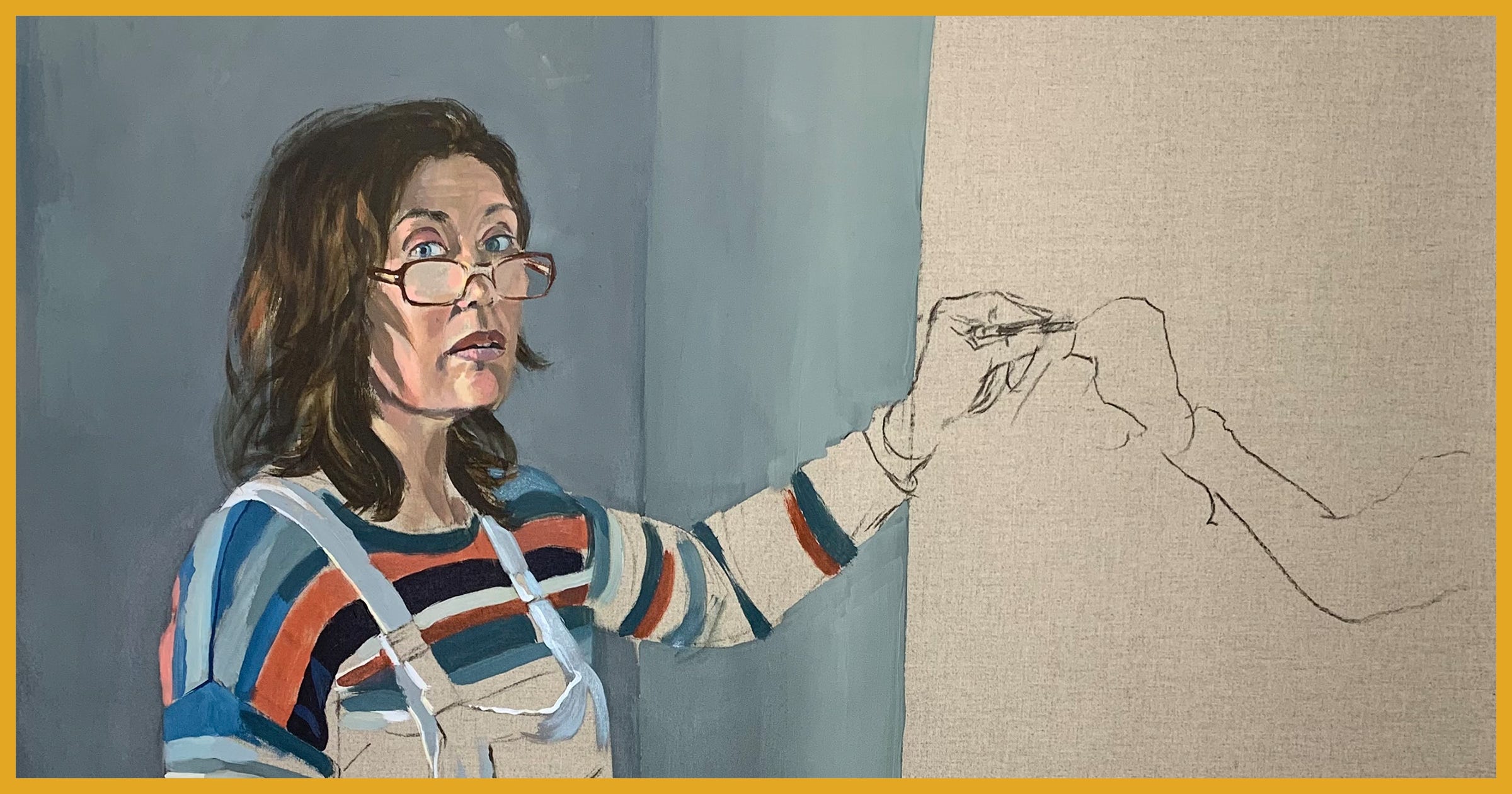
It’s that time of year: the mornings are rainy in London, and today we welcome Hamley Jenkins as the guest of How We Listen’s fourth issue. If your Instagram algorithm has gathered that you like jazz, the name might sound familiar. If you’re a regular at jazz shows across London in particular, you will probably have spotted her in the past. Hamley is a British artist who draws wonderful sketches of musicians in their element, when they’re live and on the stage. Since being asked to attend and sketch at Wilderness Festival a little over a decade ago, Hamley has developed a unique and recognizable style, and her work includes drawings of Jacob Collier, The Banger Factory, and many others.
She was kind enough to meet me in a café in Shadwell on a late Summer day to tell us how she got started in art, learning to draw on the go, the importance of giving people a chance, and how she listens.
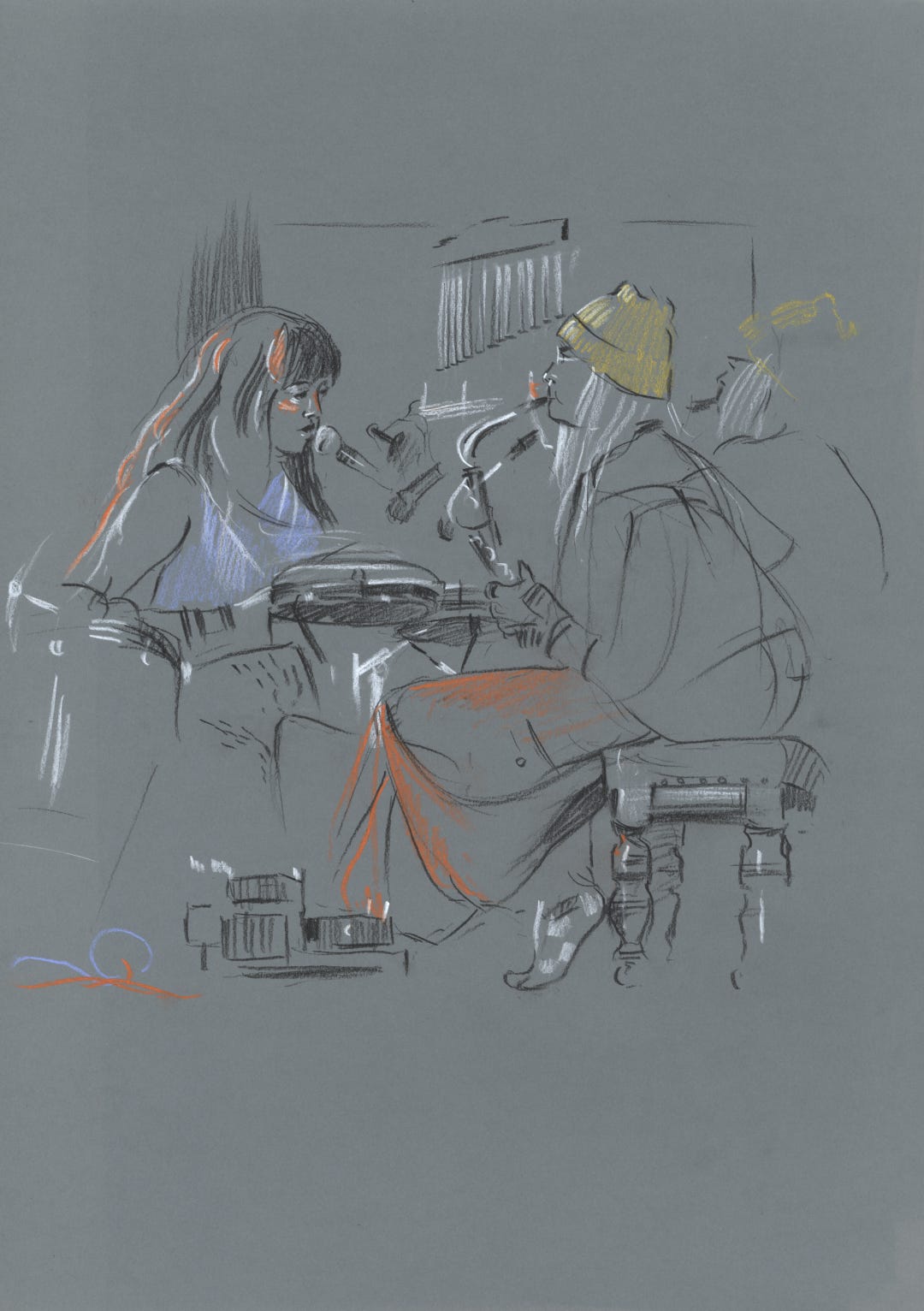
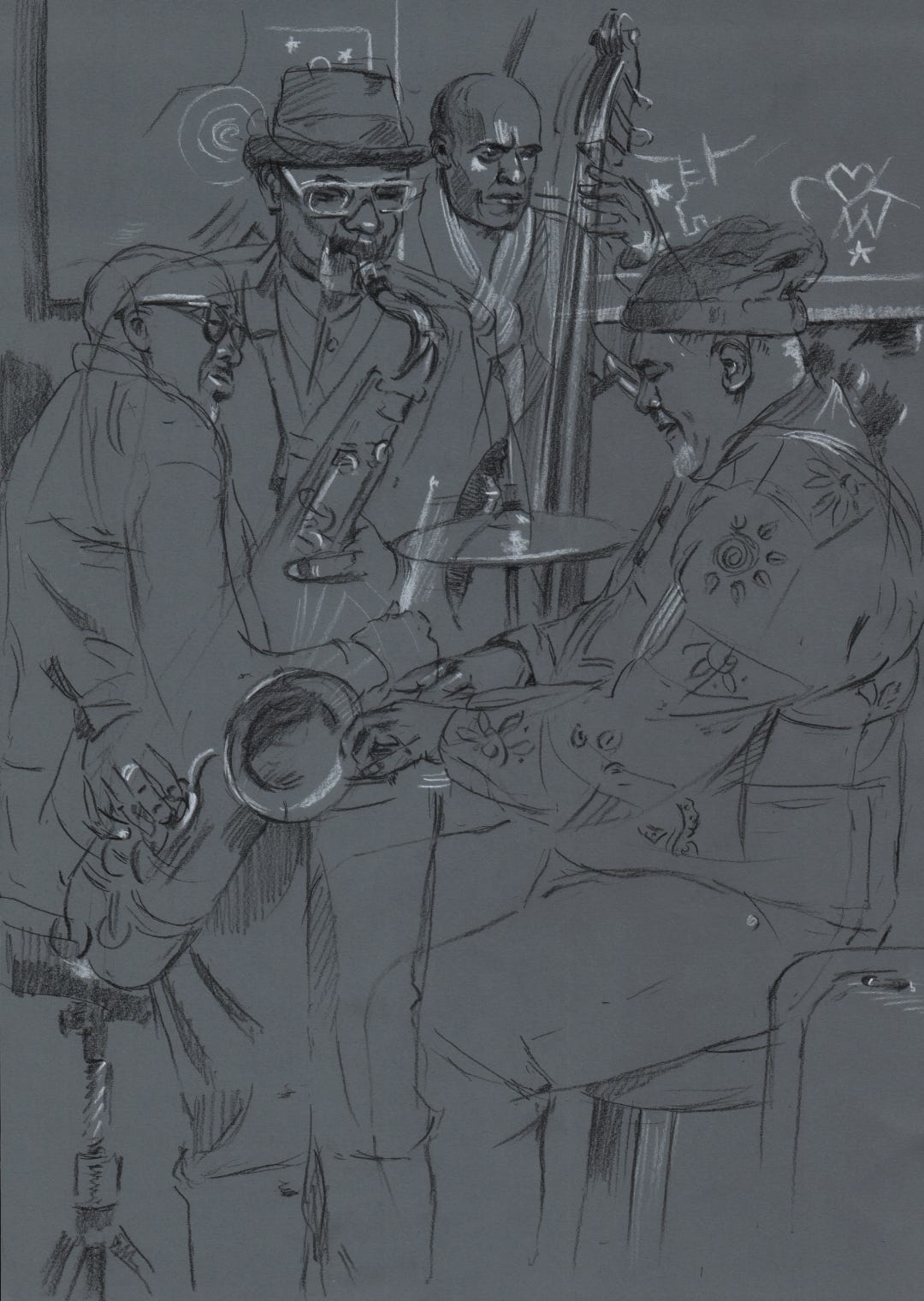
Hamley is pictured above in a self-portrait she made, and was kind enough to send over other drawings of hers to add some spark to this newsletter. You can reach out to her for commissions or to purchase prints via her website.
WHAT YOU SHOULD BE READING / WATCHING / LISTENING TO
I spend a lot of time every week scrolling through the feeds of 100+ music & culture publications (god bless RSS!), and between issues I read dozens of articles, profiles, interviews, as well as listen to intriguing podcasts, watch promising videos… I write down the ones I find most interesting and bring them to you in every issue!
WE REISSUED STEPHEN BISHOP’S DEBUT ALBUM, CARELESS, 50 YEARS LATER. IT WASN’T SO SIMPLE. (Liz The Music Manager)
Liz Kamlet is a music professional whose informational content you might have seen on Instagram or TikTok recently. She runs Windsong Entertainment and uses social media (and a newsletter) to talk about her experience in management, catalogue development, ownership, and more.
In this post she goes very in-depth into the process of what it took to reissue Stephen Bishop’s most famous record, 50 years later, and the challenges involved: from tracking down the rights holders to making careful artistic choices, including bringing in a font expert to identify the original typeface and selecting bonus tracks for the reissue. I really recommend reading this one!
“I created the gatefold package and liner notes with Steve, and I really had to tap into his memories from 50 years ago, which was not easy. Steve has a joke about memory that came from our late and great friend Michael Johnson, who sang “Bluer Than Blue.” He always said, “I’ve been having problems with my short-term memory, my long-term memory (pause)…and my short-term memory.” Steve uses it in concert sometimes and gets a good laugh.”
EVERYTHING IS VIBE CODED NOW (Network Notes)
I was reading this post from newsletter Network Notes (recommend subscribing if you want to read more about how music and technology converge) and had earmarked it as a potential recommendation. It’s a quick look at how developments in AI & specifically vibe coding are impacting digital products in every field. That includes music, as the author shows in his examples: from software for modding cheap synthesizers (more on that in this The Verge article - £paywalled£), to what could be a bleak future of programs developed by malicious actors to take advantage of security flaws… and I couldn’t keep myself from adding it to this issue after the artist RAYE took to social media to share that AI bots had hijacked registrations on a website designed to give real fans access to pre-sale for a show. 1.8 million sign-ups (capacity was 5000). That’s a very specific situation, and there are no doubt expert and organized wrongdoers behind it, but AI tools are democratizing how many people can build dangerous software, and the scale of what that software can do. AI-skeptical or not, we should all be very careful going forward, in all aspects of digital life.
Okay, this is my new favorite Instagram account.
HWL #04 - THE MIXTAPE
Wouldn’t leave you without the latest HWL mixtape!
Guillotine is on the cover of this 7-song playlist: I was so positively surprised by this young British band’s just-released EP A Lesser Key, and especially the first track “Down the Well”. It’s almost 6 minutes long and all of it is beautiful.
Also on the playlist: Hamley recommends Grifton Forbes-Amos; another banger by Crawlers; Sadurn’s indie-folk in “whole thing”; Twisted Teens are coming out with a third record in this calendar year; indie-pop duo from Berlin strongboi, and Gabriel Jacoby.
Don’t forget to save the playlist on Spotify!
Hello Hamley, and welcome to How We Listen! Very happy to have you here. Tell me a little bit about your journey with art and drawing - when did you start?
I started painting between 2005 and 2007, somewhere around then. It was my passion. At that time, I had two roughly 5-year-old girls to look after. Once they started going to state school, I had more time, and I started going to drawing sessions.
The main teacher there had an opportunity to sketch at Wilderness Festival. I was doing the drawing because I wanted to get better at painting. That is the skeleton in a painting, the composition and the drawing are the skeleton that you hang the painting off. The rest is extra – volume and tone. If you can’t draw, in the sort of painting style I was doing, it’s very difficult to become very good at it.
So I get this opportunity to sketch at Wilderness Festival as their sketch artist. Fortunately for me, it lasted 5 years, so I went 5 years in a row. I would sketch for a week, and it was mainly people who were moving. Nobody was sitting still, like they would do in my class. Each time I went, by the end of the festival I had got a lot better. But I wouldn’t do it for the rest of the year! By the time we got to year four, I was like, “I need to keep this going”. So I started trying to find places to sketch.
I began, first of all, in comedy clubs, because it was free to get in. Although as they say, when they pass around the bucket, it’s not free to get out! And also, when they saw me sketching in the audience, they would often stop their routines and say, “are you drawing?” I didn’t like the fact that I was sucking away from the show. I like being the observer.
I had been to this jazz club which was around the corner from me, the Jazzlive At The Crypt in Camberwell. And I’d loved it. I’d been going because when I was pregnant with my firstborn, I was told that if you listen to either jazz or classical music whilst they’re in the womb, it can help their language skills. So, I was like, “oh, there’s a real jazz club around the corner, and real music is better, so let’s do that.”
Was jazz a part of your life before then? Or did your love for it start at The Crypt?
My first ever boyfriend was a trumpet player and had an absolute passion for Miles Davis. My family were into classical and pop music like ABBA, which I know word for word, but I didn’t know anything about jazz. As far as I was concerned, jazz was Miles Davis. And I loved it!
When I started going to the club, I was being introduced to more and more different types of jazz. One of the things I realised of watching jazz music live [is that] it is so much better than just listening to it. Some of the stuff I couldn’t listen to, but I could watch it, because you see the skill in performance.
I started going back to this jazz club because they had a free jam session and I wanted to draw. One of the things that really struck me was the courage of the musicians. They were often quite young, some of them still studying, some of them not studying but just very talented, natural musicians, if there is even such a thing. They were going up and they were performing without knowing what they were going to perform. That just blew my mind, because I’d done a lot of theatre and I wouldn’t dream of getting up on the stage without knowing what my lines were.
I couldn’t get over it, and it really inspired me, because I also couldn’t take the drawings home and work on them after. I was looking at the drawings I’d done of these people, and thinking, “they’ve got up there, they didn’t know what they were going to do, and they just went with it.”
The guy who set up the club, Russell Occomore, who I found later was a graduate of the Camberwell School of Art, was very pro-artists. [The place] is a charity, he set it up with a number of other people, but it’s really become his space. It was always his passion and a dream, with his twin brother, to open a jazz bar. And I believe having a sketch artist was part of the vision – I didn’t even know that was possible.
He said to me, “do you want to come back?”, and that’s why I ended up going there so often, because he gave me the opportunity. And you really need people like this, who give art a chance. You need opportunity, and people manufacture opportunity, it doesn’t just happen by itself.
When you started at Wilderness Festival - did they already have others sketching there?
I think the opportunity was there because they knew of my teacher, Alex Cree. What they did have [before] was what they called “roaming players”: people who had skills like juggling, or singing, or magic. So I received free tickets and a stipend to turn up and draw.
What would they ask you to sketch? The artists, or the crowd?
I had no brief whatsoever. They said to just come and have a great time. And for me having a great time means that I draw people. I was very inspired by the musicians who were wandering around in small groups. I started drawing them. I had been very focused on audience, I think because of my theatre background. I’ve always been concerned with both sides of the stage, so I just naturally drew the people.
Again, it was one of those things where someone gave me an opportunity.
When I look at your drawings of live music, I can see a clear and recognizable style, enough so that if one popped up on my feed, I would probably know right away that it was your work. Did that style develop over time, or did you strike lightning with it immediately?
The former. And I’m quite proud of that now, because it was developed over such a long period of time. There were technical issues… you’ve been to jazz clubs: they’re very dingy. I couldn’t see my paper. Initially, I had a book light. I didn’t want to draw attention to myself, to detract from the performers.
You’re the fly on the wall.
Yeah. I really admired the musicians that I was drawing, so the last thing I wanted to do [was to draw attention away from them]. I try and keep myself less visible, at least until the interval. It was about being compact. I limit the size to A3. Jazzlive at The Crypt is quite small, so it was out of consideration for the other members of the audience. Using Wolff’s Carbon, which is a very dark, compressed charcoal, and chalk, which makes it shine. It was also about expedience, I couldn’t draw a representation of all the things in front of me, and the time limit forced that issue – I have two 45-minute sets, and I need to achieve something within that time period. I have been completely trained by it – if I’m listening to live music, I feel weird if I’m not drawing it. It is a learned reaction, but initially it was a journey of discovery.
I did try a lot of things, I experimented with color because other artists were using color in that scenario, but I found that under the very strong lighting of the stage, I couldn’t and didn’t like doing that, because I couldn’t control my color choices.
Right at the start, I did a lot of sketching at what’s called an EMOM – an Electronic Music Open Mic night. Totally anti-acoustic. They would put a whole series of amps which they ran the sounds through, and they’re moving cables… I was sketching them because my friend was organizing the night. That was extreme lighting, because they were also doing audiovisual displays, with psychedelic lights cast over my paper.
Then I moved on to jazz, which was a bit more manageable because it wasn’t so chaotic. So that really is responsible for part of the style, because it has become black and white, and it’s effectively line drawings. You could almost etch it.
Have the audiences had an impact on what you do at all?
I would be remiss if I didn’t say the audience also educated me. They are really partly responsible for how I draw. When it came to drawing, [I was very] academic. And you can’t do that very fast. They would come and give constructive criticism, and I was getting the message that [drawings] being recognisable was being rewarded. I always say that artists go towards the light, and if you encourage them, they will lean in that direction.
WHAT YOU SHOULD BE READING / WATCHING / LISTENING TO
THE WAY NIROSTA STEEL TELLS IT (Pitchfork)
Steven Hall, who releases music as Nirosta Steel, was a fixture of the Downtown New York arts scene of the ‘70s and ‘80s and a collaborator and friend of figures like musician Arthur Russell or Beat poet Allen Ginsberg. This erratic yet brilliant interview - which follows a new album with old recordings and an unexpected moment in the spotlight for him - unfolded over three phone conversations and email exchanges, and has Hall candidly discussing the revelry of those formative years, the impact of sex and drugs on creativity in his life, the AIDS crisis, and so-called fauxstalgia.
“This idea of nostalgia for a period that you never lived through, to me, is very amusing, because you think, “Oh, it would be really cool to be in that time.” No, it wasn’t.”
THE ARCHITECTS OF THE NEXT MUSICAL DISRUPTION (Welcome Magazine)
Welcome Mag bags the first joint interview with 300SkullsAndCounting & Jenny Sparks, the British duo that released the divisive album “THIS IS SPA TOWN!” on XL Recordings last month. If you’ve come across this, it won’t surprise you to hear that fingerboard tricks are involved. If you haven’t yet, I urge you to form your own opinion on it before everyone else does it for you… I’ll just leave this old Brokencyde video here.
HOW DINOSAUR JR. LEARNED TO TOLERATE ONE ANOTHER, KIND OF (Pitchfork)
Who knows how Grayson Harver Currin got so much out of J Mascis of Dinosaur Jr., a notably difficult interviewee (understatement), but the result is excellent. Props.
You mentioned the story of your boyfriend who loved Miles Davis and introduced you to a lot of jazz. I’m curious to hear how your knowledge expanded, and how you discovered new jazz artists from there?
There were several systems. One was Russell, who set up the club, he really loves his challenging jazz. I mean, he’s an art student! He told me about a “drummer poet”… I didn’t understand it at the time, although I did admire the way he played the drums. He was very technical. He had this setup where he had just two other performers, one on the guitar and one on the bass guitar. He had a microphone, and he’d drum explosively and then stop and scream “I want my treasures”, about 10 times. Then he would go back to drumming furiously, and then he would scream again. Russell said that, at the previous performance by this drummer, he was very impressed by the audience: by the end of the night, there were still five people left in the crowd. Most of them left after the first hour, because the jazz audience is so tolerant.
I was being educated in this place for at least the first two years, because I couldn’t go anywhere else, I couldn’t afford to. I didn’t realise what was happening, I was just trying to make my drawing better, and I really enjoyed doing it to the music.
What is it about watching music live that most excites you? What inspires you as you draw?
One of the things I love about jazz musicians is that there is this collaborative element. For any musician, you have to be able to collaborate with your fellow bandmates. And it’s very important, especially in jazz, that you listen to each other. There’s this conversation that’s occurring between other people on the stage that you’re watching. As an audience, you’re in a position where you’re a voyeur – and I’m an artist, that’s something I like doing anyway, I’m there to watch.
Everybody’s there to watch, and that’s so much part of the joy of the music. If people around you are very enthusiastic, you’re met with a very positive response before you’ve even listened to the musician.
Is this still the main way that you discover new music? Going and drawing something, watching it unfold in a live environment?
Well, I have to give credit to Instagram, Spotify and Qobuz, for introducing me to new musicians. You have to train your algorithm, and I was accidentally doing that by going to these jam sessions and following the people when I did a drawing.
And because of that, I would get pinged with other musicians’ work, who were friends of them.
I would also turn up to jam sessions, and see somebody like Grifton Forbes-Amos, who I really love. And then I’d keep seeing other performers who were their friends, who would perform with them, like Sokkyo. Because of that, I was going to other jam sessions, and I would follow them on Instagram. It’s all enmeshed.
Because you follow these musicians on these apps, and you get other suggestions, it takes the algorithm away from the trash that they deliver up to you.
How do you follow up, once an artist has caught your eye on social media? Do you keep a list of things you want to go back and listen to? And are there any other artists who have impressed you?
I’m really bad [at that]. I should be good, I used to be a secretary. I have notes all over the place, and sometimes I’m on my desk and find something I wrote down 6 months ago. I would like to say there’s a “later” list, but I also believe in synchronicity. It’s part of the magic of the world, isn’t it? Sometimes you just bump into people or… something happens.
There’s an artist called Lilah Esther, she set up a jam session that I went up and sketched, and that introduced me to a lot of people I didn’t know before.
There is a pianist called Luke Bacchus, I saw him many years ago with an artist called Amy Gadiaga. She’s originally French and sings and plays the double bass. Another luminary like Esperanza Spalding. Amy impressed me so much that I followed them. And then a few years down the line, Luke gets nominated for Young Jazz Musician of the Year, or something like that!
Thank you for joining How We Listen, Hamley. I normally do this at the beginning of these conversations, but I still want to ask you, as nobody can do it better than you… How would you describe yourself and what you do?
What I always say to people is that I draw jazz musicians, live. With an emphasis on the word “live”.
This interview was edited for length and clarity.
Thank you for spending your time with How We Listen, and thanks to Hamley for being a part of it.
One of Hamley’s recommendations was Lilah Ester - check out a song of hers as you leave!